
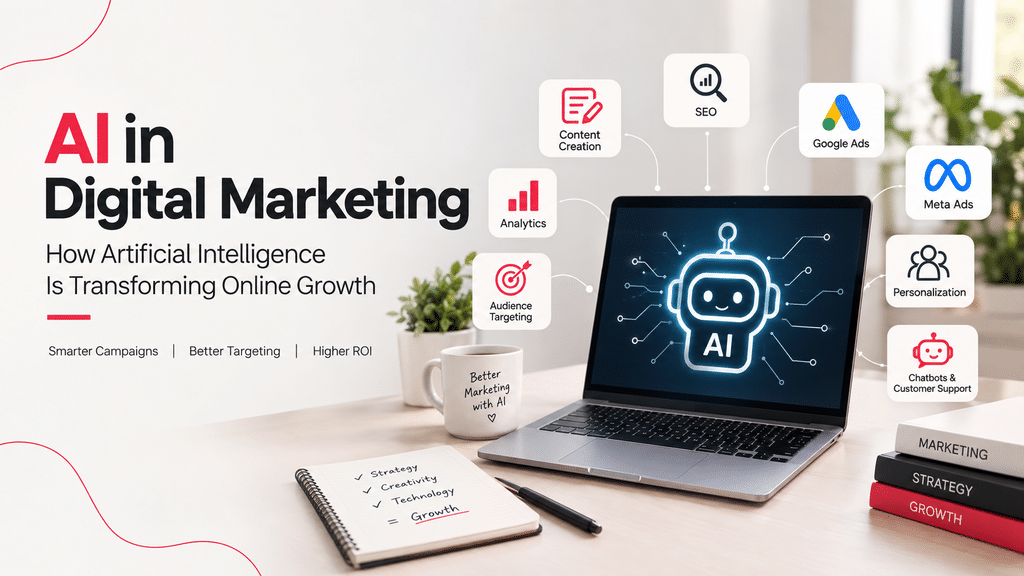
Artificial Intelligence (AI) is changing the way businesses market their products and connect with customers online. From creating content and analyzing customer behavior to optimizing advertisements and improving SEO, AI has become an important part of modern digital marketing.
But AI is not simply about automation. When used strategically, it can help marketers save time, understand their audience better, make smarter decisions, and create more personalized customer experiences.
In this blog, we’ll explore how AI is transforming digital marketing, its key applications, benefits, challenges, and how businesses can use it effectively.
What Is AI in Digital Marketing?
AI in digital marketing refers to using artificial intelligence technologies to analyze data, identify patterns, automate repetitive tasks, predict customer behavior, and improve marketing campaigns.
For example, AI tools can help marketers:
- Generate content ideas
- Analyze customer behavior
- Optimize Google and Meta Ads
- Find SEO opportunities
- Personalize marketing messages
- Predict customer interests
- Automate customer support
- Analyze campaign performance
Instead of replacing marketers, AI can work as a powerful assistant that helps them make faster and more data-driven decisions.
Why Is AI Important for Digital Marketing?
Traditional marketing often depends on manual research, assumptions, and repetitive tasks. AI can process large amounts of information much faster and identify patterns that may be difficult to find manually.
For businesses, this can mean:
Better Decisions: AI can analyze marketing data and identify trends that support better campaign decisions.
Time Savings: Repetitive tasks such as reporting, content ideas, and data analysis can be automated.
Personalization: AI can help businesses deliver more relevant content and offers to different customer segments.
Improved Customer Experience: Chatbots and AI-powered assistants can provide quick responses to common customer questions.
Better Campaign Optimization: AI can analyze campaign performance and help marketers identify opportunities for improvement.
1. AI-Powered Content Creation
Creating high-quality content consistently can be time-consuming. AI tools can assist marketers with brainstorming topics, creating outlines, generating drafts, rewriting content, and developing social media ideas.
For example, a digital marketer can use AI to generate multiple blog topic ideas based on a specific audience or industry.
However, AI-generated content should not simply be published without review. Human creativity, experience, fact-checking, brand voice, and originality are still essential.
Best approach: Use AI for assistance, not as a complete replacement for human creativity
2. AI in SEO
AI is also changing the way marketers approach Search Engine Optimization (SEO).
AI can help with:
- Keyword research
- Search intent analysis
- Content ideas
- Competitor research
- Content optimization
- Identifying content gaps
- Creating content outlines
For example, instead of focusing only on a single keyword, marketers can analyze what users are actually searching for and create content that answers their questions.
The goal is not simply to add keywords to a page. The goal is to create useful content that satisfies the user’s search intent.
3. AI for Google Ads
AI has become an important part of paid advertising.
Google Ads uses machine learning to help advertisers optimize campaigns, identify potential customers, and determine when ads may be more likely to perform.
Marketers can use AI-assisted advertising features for:
- Audience targeting
- Bidding optimization
- Ad variations
- Performance analysis
- Campaign optimization
However, successful advertising still requires the right strategy, creative messaging, landing pages, budget management, and continuous monitoring.
4. AI in Meta Ads
AI is also widely used in social media advertising platforms such as Facebook and Instagram.
AI can help advertisers identify audiences, optimize delivery, and improve campaign performance based on user behavior and campaign signals.
For marketers, this means the focus is gradually shifting from manually controlling every small setting toward creating strong creative assets, clear offers, and well-defined campaign goals.
5. Personalized Marketing
Customers don’t all have the same interests or needs.
AI can analyze customer interactions and behavior to help businesses deliver more relevant experiences.
For example, an e-commerce website might recommend products based on a customer’s previous browsing or purchasing behavior.
Personalization can be used in:
- Email marketing
- Product recommendations
- Website experiences
- Advertisements
- Offers and promotions
- Customer communication
When done correctly, personalization can make marketing feel more relevant instead of generic.
6. AI Chatbots and Customer Support
AI-powered chatbots can help businesses respond to frequently asked questions and provide support at any time.
For example, a customer visiting a website might ask:
“Do you deliver to Pune?”
Instead of waiting for a human representative, an AI chatbot can provide an immediate response if the information is available.
Businesses can use chatbots for:
- FAQs
- Product information
- Lead generation
- Appointment booking
- Basic customer support
- Order-related questions
Human support is still important for complex or sensitive customer issues.

Benefits of AI in Digital Marketing
AI can provide several advantages when it is implemented strategically.
Saves Time
AI can automate repetitive marketing tasks, allowing marketers to focus more on strategy and creativity.
Improves Data Analysis
Businesses generate huge amounts of marketing data. AI can help analyze this information and identify useful patterns.
Supports Personalization
AI makes it easier to create experiences based on customer interests and behavior.
Helps Optimize Campaigns
AI-powered systems can analyze campaign signals and support ongoing optimization.
Improves Productivity
Instead of spending hours starting from scratch, marketers can use AI to generate ideas, organize information, and speed up workflows.
AI vs Human Marketers: Will AI Replace Digital Marketers?
One of the biggest questions surrounding AI is whether it will replace digital marketers.
The more realistic answer is that AI is changing the role of marketers rather than simply eliminating it.
AI can process information, identify patterns, and automate many tasks. But marketers still need to understand:
- Brand positioning
- Customer psychology
- Business goals
- Creativity
- Strategy
- Communication
- Ethics
- Market context
A marketer who knows how to use AI effectively can potentially work faster and focus more time on strategic thinking.
The future is likely to be less about AI vs. humans and more about humans using AI effectively.
Challenges of Using AI in Digital Marketing
Despite its advantages, AI also has limitations.
Lack of Human Understanding
AI may generate technically correct content that doesn’t fully understand a brand’s personality or audience.
Accuracy Issues
AI-generated information can sometimes be incorrect or outdated, so important information should always be reviewed.
Generic Content
Using AI without editing can result in repetitive or generic content that fails to provide a unique perspective.
Privacy Concerns
Businesses need to handle customer data responsibly and follow applicable privacy and data-protection requirements.
Overdependence on Automation
Marketing still requires human judgment. Automating everything can reduce creativity and lead to poor customer experiences.
How Businesses Can Use AI Effectively
The best way to use AI is to combine technology with human expertise.
Here are a few practical steps:
Start with a clear goal: Decide what problem you want AI to solve.
Use AI for research and ideas: Let AI help you explore topics, audiences, and content opportunities.
Keep humans involved: Review and improve AI-generated content before publishing.
Test and optimize: Monitor campaign results and use real performance data to improve your strategy.
Protect customer data: Avoid sharing sensitive information with AI tools unnecessarily.
Focus on value: Technology should improve the customer experience, not simply increase the amount of content you produce.
The Future of AI in Digital Marketing
AI is likely to become even more integrated into digital marketing workflows.
Marketers will increasingly use AI for content creation, campaign optimization, customer insights, personalization, analytics, and automation.
But technology alone will not create successful marketing campaigns.
The businesses that benefit most will be those that combine AI + data + creativity + human strategy.
AI can help marketers work faster. Human marketers are still responsible for deciding what should be done, why it should be done, and whether it actually creates value for the customer.
Final Thoughts
AI is no longer just a futuristic concept. It has already become part of modern digital marketing.
From SEO and content creation to Google Ads, Meta Ads, personalization, and customer support, AI is helping businesses make marketing more efficient and data-driven.
But the goal should not be to use AI simply because it is trending.
The real goal is to use AI where it creates meaningful value.
Use AI for speed. Use data for decisions. Use creativity for connection. And use human strategy to bring everything together.
Frequently Asked Questions
1. What is AI in digital marketing?
AI in digital marketing means using artificial intelligence to analyze data, automate tasks, understand customer behavior, personalize experiences, and improve marketing activities.
2. Can AI replace digital marketers?
AI can automate many marketing tasks, but human creativity, strategy, judgment, and understanding of business and customers remain important.
3. How is AI used in SEO?
AI can assist with keyword research, search intent analysis, content planning, competitor research, and content optimization.
4. Is AI-generated content good for SEO?
AI can assist with content creation, but content should provide genuine value, be accurate, original, useful to readers, and reviewed by humans.
5. What is the biggest benefit of AI in marketing?
One major benefit is the ability to process large amounts of information quickly and help marketers automate repetitive tasks and make more informed decisions.